|
|
|
| |
| BARC Studies in Cold Fusion |
New Energy Times Reprint of the Bhabha Atomic Research Centre 1500 Report
|
x |
|
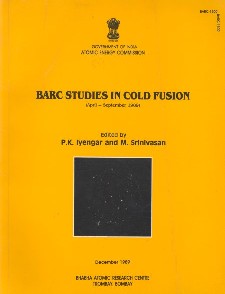
| BARC Studies in Cold Fusion, April - September 1989, Edited by Padmanabha Krishnagopala Iyengar and Mahadeva Srinivasan, Government of India,
Atomic Energy Commission, Bhabha Atomic Research Centre,
Trombay, Bombay 153 pages, December 1989 (Republished by New Energy Times, Feb. 2009) |
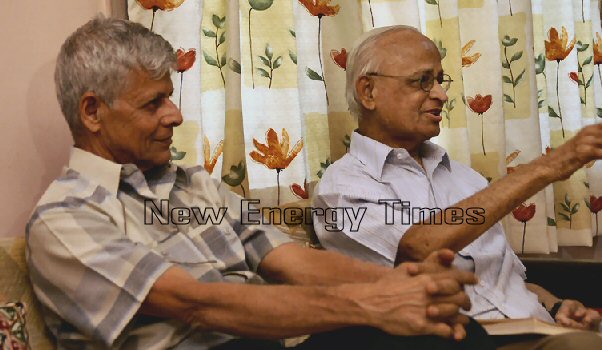 
P.K. Iyengar and M. Srinivasan (Photo: M.McKubre) |
| Preface to the New Energy Times Reprint of the BARC-1500 Report
It is appropriate that an international conference on "cold fusion," now called Low Energy Nuclear Reactions (LENR) is being held next month at Salt Lake City, Utah, to mark the twentieth anniversary of the historic Fleischmann-Pons University of Utah announcement which was first made there.
It is obvious by now that experiments on this field have been repeated by several groups in the world and there is nothing fundamentally wrong with the observations.
If the observed phenomena do not fit within our text-book understanding of nuclear phenomena, that is a problem for science to solve. Nature demonstrates many phenomena which we don't yet understand. This does not mean we should not explore further.
The need to satisfy peer reviews, (in fact there could be no perfect peers at any time in any subject,) should not come in the way of continued exploration. We are glad that an archive is being created to mark this occasion. We congratulate Steven B. Krivit and New Energy Times for this initiative.
- Dr. P. K. Iyengar, Chairman (retired), Atomic Energy Commission, India
February 23, 2009
- M. Srinivasan, Associate Director (retired), Physics Group, Bhabha Atomic
Research Centre (BARC), India
February 23, 2009
|
| 2009 Srinivasan ACS Presentation - "Observation of neutrons and tritium in a wide variety of LENR configurations: BARC results revisited," 3rd International New Energy Technology Symposium at the 237th American Chemical Society National Meeting March, 2009, Salt Lake City, Utah, USA
Abstract
Early in April 1989 the Bhabha Atomic Research Centre (BARC), Mumbai, embarked on a massive experimental campaign involving close to 50 scientists to investigate whether there was any basis to the reported claims of occurrence of “fusion reactions” at room temperature in Pd-D2O electrolysis cells. Deuterium gas/plasma loaded titanium targets as well as nickel-light hydrogen electrolytic systems were also studied for nuclear debris. Within weeks the production of neutrons and tritium was confirmed in over a dozen independent experimental configurations, with neutron yield being almost eight orders of magnitude smaller than that of tritium. This so called “branching ratio anomaly” has since been identified as a unique signature of lenr devices by other groups around the world. Autoradiography of deuterium gas/plasma loaded cold working titanium metal targets indicated that tritium production occurs primarily in localized hot spots, predominantly defect sites created during machining of the electrodes/targets. |
| Contents (All papers are contained in New Energy Times Reprint. Some individual papers are downloadble from LENR-CANR.org)
|
Part A: Electrolytic Cell Experiments |
| A1. Cold Fusion Experiments Using a Commercial Pd-Ni Electrolyser M.S. Krishnan, S.K. Malhotra, D.G. Gaonkar, M. Srinivasan, S.K. Sikka, A. Shyam, V. Chitra, T.S. Iyengar and P.K. Iyengar |
| A2. Preliminary Results of Cold Fusion Studies Using a Five Module High Current Electrolytic Cell M.G. Nayar, SK. Mitra, P. Raghunathan, M.S. Krishnan, S.K. Malhotra, D.G. Gaonkar, S.K. Sikka, A Shyam and V. Chitra |
| A3. Observation of Cold Fusion in a Ti-SS Electrolytic Cell M.S. Krishnan, S.K. Malhotra, D.G. Gaonkar, M.G. Nayar, A. Shyam and S.K. Sikka |
| A4. Multiplicity Distribution of Neutron Emission in Cold Fusion Experiments A. Shyam, M. Srinivasan, S.B. Degwekar and L.V. Kulkarni |
| A5. Search for Electrochemically Catalysed Fusion of Deuterons in Metal Lattice T.P. Radhakrishnan, R. Sundaresan, J. Arunachalam, V. Sitarama Raju, R. Kalyanaraman, S Gangadharan and P.K. Iyengar |
| A6. Tritium Generation during Electrolysis Experiment T.P. Radhakrishnan, R. Sundaresan, S. Gangadharan, B.K. Sen, T.S. Murthy |
| A7. Burst Neutron Emission and Tritium Generation from Palladium Cathode Electrolytically Loaded with Deuterium, G. Venkateswaran, P.N. Moorthy, K.S. Venkateswarlu, S.N. Guha, B. Yuvaraju, T. Datta, T.S. Iyengar, M.S. Panajkar, K.A. Rao and Kamal Kishore (subsequently withdrawn by authors) |
| A8. Verification Studies in Electrochemically Induced Fusion of Deuterons in Palladium Cathodes H. Bose, L.H. Prabhu, S. Sankarnarayanan, R.S. Shetiya, N. Veeraraghavan, P.V. Joshi, T.S. Murthy, B.K. Sen and K.G.B. Sharma |
| A9. Tritium Analysis of Samples Obtained from Various Electrolysis Experiments at BARC T.S. Murthy, T.S. Iyengar, B.K. Sen and T.B. Joseph |
| A10. Material Balance of Tritium in the Electrolysis of Heavy Water M.S. Krishnan, S.K. Malhotra and S.K. Sadhukhan |
| A11. Technique for Concentration of Helium in Electrolytic Gases for Cold Fusion Studies K. Annaji Rao |
| Part B: D2 Gas Loading Experiments
|
| B1. Search for Nuclear Fusion in Gas Phase Deuteriding of Titanium Metal P. Raj, P. Suryanarayana, A. Sathyamoorthy and T. Datta |
| B2. Deuteration of Machined Titanium Targets for Cold Fusion Experiments V.K. Shrikande and K.C. Mittal |
| B3. Autoradiography of Deuterated Ti and Pd Targets for Spatially Resolved Detection of Tritium Produced by Cold Fusion R.K. Rout, M. Srinivasan and A. Shyam |
| B4. Evidence for Production of Tritium via Cold Fusion Reactions in Deuterium Gas Loaded Palladium M.S. Krishnan, S.K. Malhotra, D.G. Gaonkar, V.D. Nagvenkar and H.K. Sadhukhan |
Part C: Theoretical Papers
|
| C1. Materials Issues in the So-Called 'Cold Fusion' Experiments R. Chidambaram and V.C. Sahni |
| C2. Remarks on Cold Fusion B.A. Dasannacharya and K.R. Rao |
| C3. The Role of Combined Electron-Deuteron Screening in D-D Fusion in Metals S.N. Vaidya and Y.S. Mayya |
| C4. A Theory of Cold Nuclear Fusion in Deuterium Loaded Palladium Swapan K. Ghosh, H.K. Saidhukhan and Ashish K. Dhara |
| C5. Fracture Phenomena in Crystalline Solids: A Brief Review in the Context of Cold Fusion T.C. Kaushik, M. Srinivasan and A. Shyam |
|
|
|
|
